Psychodiagnostics: The First Step in Cognitive Psychotherapy
Psychodiagnostics is the systematic recognition and classification of mental disorders — and therefore the first step in any serious psychotherapy. A diagnosis is not a bureaucratic formality but a map of the thinking errors involved: whoever does not know which disorder is present cannot correct the thinking that produces it.
This site belongs to Dr. Dietmar Luchmann, LLC, the operator of the Anxiety Clinic at Lake Zurich (Angstambulanz am Zürichsee) and publisher of the online journal Psychotherapie. The domain carries the German word Psychodiagnostik - psychodiagnostics - from the professional vocabulary of its founder’s native language. The page classifies the disorders that cognitive psychotherapy treats, states the official ICD-11 and ICD-10 classification codes, and shows how each disorder is recognized and from what it must be distinguished.
Whoever wants to take the next step after this orientation will find it at the end of this page: two free entry steps, leading via the portal Psychotherapie.com to Written Cognitive Psychotherapy (WCP), Video-Based Cognitive Psychotherapy (VCP), or Cognitive Psychotherapy in a Day Block (DCP).
What Psychodiagnostics Delivers — and What It Does Not
Psychodiagnostics answers two different questions that are frequently confused. The first is disorder-related: Which disorder is present? It is answered with the instruments of clinical classification — today according to the ICD-11 of the World Health Organization, whose codes this page states throughout. The second is indication-related: Which therapeutic path suits this particular person? It decides whether cognitive psychotherapy is conducted in writing, by video, or in a day block.
The internet appears to answer both questions in seconds. Whoever types symptoms into a search engine receives a diagnosis; whoever clicks through the five questions of a portal self-test receives a second, usually more dramatic one — for a test that certifies health sells no treatment. Such instant diagnostics is not psychodiagnostics but customer acquisition. It confuses symptoms with disorders: sadness is not depression, stage fright is not social anxiety disorder, a love of order is not obsessive-compulsive disorder. A diagnosis arises not from checking off symptom lists but from weighing them with expertise - by duration, intensity, course, and impairment.
The free suitability test on Psychotherapie.com therefore deliberately makes no diagnosis of a disorder. It examines the prerequisites for Written Cognitive Psychotherapy: the readiness to think, read, and write for oneself. The disorder-related diagnosis follows later, in the flat-rate psychodiagnostics and probationary phase with which every psychotherapy at Dr. Dietmar Luchmann, LLC, begins. First the diagnosis, then the psychotherapy — whoever reverses the order is treating blindly.
The Disorders at a Glance — ICD-11 and ICD-10
The following overview classifies the disorders that cognitive psychotherapy treats. The code before the diagnostic label corresponds to the new ICD-11 classification, the code in parentheses after it to the older ICD-10. Each entry first describes the core picture of the disorder and then states how it is recognized and from what it must be distinguished.
This overview serves as a first orientation and does not replace a psychodiagnostic assessment.
Anxiety or Fear-Related Disorders
- 6B00 Generalized Anxiety Disorder (F41.1)
- Over several months, on most days, a general apprehensiveness or free-floating tension that is not tied to any particular situation. Accompanied by restlessness, muscle tension, autonomic overarousal, and difficulties with concentration, irritability, and sleep. The worries usually circle around everyday life, family, or health and exhaust quickly. Recognizable by the persistent chains of worry — in contrast to panic disorder, which runs in attacks. The constant physical tension leads many sufferers first to physicians rather than to psychotherapists.
- 6B01 Panic Disorder (F41.0)
- Recurrent, unexpected panic attacks: abrupt, intense fear with racing heart, shortness of breath, chest tightness, dizziness, trembling, feelings of unreality, and the fear of dying or losing control. Between the attacks remains the anticipatory anxiety of the next one, often with growing avoidance. The core of the disorder is the misinterpretation of harmless bodily signals as catastrophe. The diagnosis presupposes a prior medical examination that rules out an organic cause — only then is it established that the heart is healthy and the thinking must be treated. Frequently combined with agoraphobia.
- 6B02 Agoraphobia (F40.0)
- Marked fear of situations from which quick escape would be difficult or in which help would be unavailable in an emergency - crowds, public transportation, enclosed or open spaces, standing in line, being outside the home alone -, which are avoided or endured only under intense anxiety. The radius of action narrows progressively. Agoraphobia frequently develops secondarily after panic attacks. What distinguishes it from social anxiety disorder is the object of the fear: here the impossibility of escape, there the judgment of others.
- 6B03 Specific Phobia (F40.2)
- A marked, persistent fear of a circumscribed object or situation that almost always triggers immediate anxiety and is avoided or endured under anxiety, although the fear is out of proportion. The types: animals, the natural environment such as heights or thunderstorms, blood-injection-injury, and situational triggers such as flying or confined spaces. Onset usually in childhood. A diagnostic peculiarity: the blood-injection phobia is the only phobia with a tendency to faint — the circulation drops instead of rising.
- 6B04 Social Anxiety Disorder (F40.1)
- Marked fear of social situations involving possible critical scrutiny - speaking before groups, performing, meeting people -, carried by the worry of embarrassing oneself or being rejected. Visible signs such as blushing, trembling, or sweating are particularly feared; not infrequently, alcohol serves as an unfit coping device. What distinguishes it from mere shyness is suffering and impairment; what distinguishes it from avoidant personality disorder is the situational binding of the fear with an essentially intact self-image — more on this below.
- 6B05 Separation Anxiety Disorder (F93.0)
- An excessive fear of separation from close attachment figures, combined with worry about their or one’s own well-being. Contrary to common assumption, it occurs not only in children but also in adults, for instance in relation to partners or children. Recognizable by physical symptoms when separation threatens and by the avoidance of being alone and of travel.
- 6B06 Selective Mutism (F94.0)
- The consistent failure to speak in certain social situations - at school, for instance -, while speech is normal in familiar surroundings. The capacity for speech itself is intact; neither a language disorder nor insufficient language proficiency explains the silence. Onset usually in childhood, frequently combined with social anxiety.
Obsessive-Compulsive or Related Disorders
- 6B20 Obsessive-Compulsive Disorder (F42.-)
- Recurrent obsessions - intrusive, unwanted, laden with anxiety or disgust - and/or compulsions and rituals meant to neutralize the tension they trigger; time-consuming or markedly impairing. Frequent themes are contamination, checking, symmetry, and aggressive or sexual contents, accompanied by avoidance and reassurance-seeking. Insight into the senselessness of the compulsions varies. To be distinguished from the obsessive personality structure: compulsions are experienced as alien and tormenting, a love of order as one’s own.
- 6B21 Body Dysmorphic Disorder (F45.2)
- A persistent, distressing preoccupation with one or more perceived defects in one’s appearance that others hardly notice or do not notice at all; along with repeated mirror checking, camouflaging, comparing, and reassurance-seeking. Recognizable by the high co-occurrence of depression and by the risk of useless cosmetic procedures — the defect resides in the judgment, not in the face. Note: body dysmorphic disorder (6B21) and hypochondriasis (6B23) both point to F45.2 because the older ICD-10 subsumed both under hypochondriacal disorder; only the ICD-11 separates them as independent diagnoses.
- 6B23 Hypochondriasis / Health Anxiety (F45.2)
- A persistent fear or conviction of being or becoming seriously ill, with excessive health-related checking or equally excessive avoidance — and this despite adequate examination and reassurance. Recognizable by constant self-observation and by doctor shopping: every medical all-clear reassures only briefly, then the search begins anew. To be distinguished from bodily distress disorder, in which the symptom stands in the foreground, not the fear.
- 6B24 Hoarding Disorder (no direct ICD-10 equivalent)
- A persistent difficulty in parting with possessions regardless of their value, with a strong urge to keep them and distress when discarding; the accumulations obstruct living spaces and impair their use, frequently combined with excessive acquiring. Insight is often limited. To be distinguished from collecting: the collector orders and displays, the hoarder piles up and conceals. A new diagnosis of the ICD-11 without a direct equivalent in the ICD-10.
- 6B25 Body-Focused Repetitive Behavior Disorders (F63.3)
- Recurrent hair pulling (trichotillomania) or skin picking with tissue damage, despite repeated unsuccessful attempts to reduce the behavior. Recognizable by the automatic or tension-regulating character of the behavior as well as by shame and the concealment of the damage.
Disorders Specifically Associated with Stress
- 6B40 Post-Traumatic Stress Disorder (F43.1)
- Follows exposure to an extremely threatening or horrifying event and shows three core elements: re-experiencing the event in the here and now - intrusions, nightmares, flashbacks -, avoiding everything that recalls it, and a persistent sense of current threat with heightened vigilance and an exaggerated startle response. The diagnostic core criterion is the present-tense character of the intrusions: the memory is not remembered but relived. Accompanied by sleep disturbances, irritability, and feelings of guilt and shame.
- 6B41 Complex Post-Traumatic Stress Disorder (no direct ICD-10 equivalent)
- Comprises all core criteria of post-traumatic stress disorder and, beyond them, persistent disturbances in self-organization: difficulties in regulating emotions, a lastingly negative self-image with feelings of worthlessness, shame, and guilt, and recurring problems with closeness and trust. It usually develops after prolonged or repeated traumatization from which escape was difficult. To be distinguished from borderline personality disorder, in which fear of abandonment, identity diffusion, and self-damaging impulsivity stand in the foreground — it does not belong to this treatment spectrum, as the following section on limits explains.
- 6B42 Prolonged Grief Disorder (no direct ICD-10 equivalent)
- After the loss of a close person, a persistent, deep longing for or mental preoccupation with the deceased, together with intense emotional pain, beyond the socioculturally expected measure - at least six months - and markedly impairing. Recognizable by identity disturbance (“a part of me has died”), emotional numbness, and loss of meaning. The distinction is delicate and important: grief is not an illness; only duration and impairment make the diagnosis.
- 6B43 Adjustment Disorder (F43.2)
- An excessive, distressing reaction to an identifiable psychosocial stressor - a separation, a loss, a professional change -, marked by rumination, worry, and difficulties in adapting. Onset usually within a month; the complaints as a rule recede within about six months after the stressor ceases or is mastered. The symptoms remain below the threshold of depression and anxiety disorder; diagnostically, adjustment disorder is a residual category after the specific disorders have been excluded.
Mood Disorders
- 6A70 Depressive Episode, Single (F32.-)
- Over at least two weeks, almost daily, a depressed mood and/or a markedly diminished interest in things that otherwise give pleasure, combined with several further symptoms: difficulties with concentration and decision-making, reduced self-worth or inappropriate guilt, hopelessness, thoughts of death, changes in sleep and appetite, loss of energy. It is a first occurrence without previous manic phases. Recognizable by daily fluctuations with a morning low, rumination, social withdrawal, and frequently somatic complaints; the severity is measured by symptom count and loss of functioning.
- 6A71 Recurrent Depressive Disorder (F33.-)
- At least two depressive episodes, separated by several months largely free of significant mood symptoms; the prevention of further episodes carries particular weight. The diagnostic key question is: Was there ever a hypomanic phase? If it is overlooked or never asked, the diagnosis is wrong — and the correct one is bipolar type II disorder.
- 6A72 Dysthymic Disorder (F34.1)
- A predominantly depressed mood lasting at least two years, below the threshold of a depressive episode, with accompanying symptoms in drive, self-worth, and sleep, and without symptom-free phases of more than two months. It often begins early and is therefore frequently misread as a character trait — a diagnostic error with consequences, for what passes as character goes untreated. When a depressive episode settles on top of the dysthymia, the clinic speaks of “double depression.”
- 6A73 Mixed Depressive and Anxiety Disorder (F41.2)
- Over at least two weeks, depressive and anxiety symptoms occur simultaneously without either syndrome by itself presenting the full picture of an independent disorder; the impairment is nonetheless marked. Typical is the mixture of autonomic tension, chains of worry, and depressed mood. The diagnosis is subordinate: as soon as one syndrome is fully met, that one applies.
- 6A60 Bipolar Type I Disorder (F31.-)
- At least one manic or mixed episode of, as a rule, at least one week: elevated or irritable mood with increased activity and energy, plus grandiose ideas, reduced need for sleep, pressured speech, flight of ideas, distractibility, and risk-laden behavior; depressive episodes usually occur as well. In acute mania, psychotic symptoms are possible and the danger to self and others is high — the acute phase belongs in psychiatric care, as the section on limits explains.
- 6A61 Bipolar Type II Disorder (F31.8)
- At least one hypomanic episode of at least four days - without marked functional impairment and without psychotic symptoms - and at least one depressive episode; full mania never occurs. The diagnostic problem: the hypomania is experienced as a good, productive phase, not as pathological, and therefore goes unreported to the psychotherapist. It is the most frequent source of the misdiagnosis “depression” — the suffering is determined by the depressive poles, the truth by the concealed highs.
- 6A62 Cyclothymic Disorder (F34.0)
- Over at least two years, numerous hypomanic and depressive symptom periods, each remaining below the episode threshold, without symptom-free phases of more than two months. The unstable mood is often misread as “temperament” — the same error as with dysthymia, only in both directions.
Personality Disorders
With personality disorders, the ICD-11 has changed the system: the categorical types of the ICD-10 (F60.-) have been abolished. In their place stands the single diagnosis of personality disorder (6D10) with a severity of mild, moderate, or severe, specified by trait domains (6D11.-) that describe the individual pattern. The familiar ICD-10 labels therefore remain recognizable as patterns but no longer carry ICD-11 codes of their own. Two of these patterns belong to the treatment spectrum of cognitive psychotherapy:
- Anxious-Avoidant Pattern (ICD-10: F60.6; ICD-11: 6D10 with Negative Affectivity and Detachment)
- An enduring pattern of tension, apprehensiveness, and a sense of personal inadequacy, combined with hypersensitivity to criticism and the avoidance of contacts and tasks for fear of rejection. The most important distinction leads to social anxiety disorder: there, the fear is bound to situations and the self-image is essentially intact; here, an enduring self-image of inadequacy shapes all areas of life — it is not the performance that is feared but one’s own person that is held insufficient.
- Narcissistic Pattern (ICD-10: F60.8; ICD-11: 6D10 with Features of Dissociality: Grandiosity and Self-Centeredness)
- An enduring pattern of grandiose self-experience, entitlement, and lack of empathy, combined with pronounced vulnerability to slights behind the self-assured façade. Diagnostically remarkable: sufferers rarely seek help because of the narcissism but because of its consequences — depressions following narcissistic injury, professional and relationship conflicts that recur with the same regularity as the thinking errors producing them.
Borderline personality disorder does not belong to this spectrum; the reasons are stated in the following section.
Giftedness, too, can trigger - through the social exceptionality it often enforces - anxiety disorders, social phobias, and depression. Giftedness is not a disorder, and yet it is diagnostically relevant: whoever overlooks the exceptional position misses the cause of the disorder under treatment. Anxiety and depressive conditions of this origin can be resolved by the same method just as effectively as those of any other origin.
What Outpatient Psychotherapy Must Not Attempt
Part of psychodiagnostics is honesty about its consequences. Not every diagnosis leads into outpatient psychotherapy — in whatever form and with whatever provider. Severe depressive episodes, acute suicidality, manic and mixed episodes, psychotic states, and borderline personality disorder belong in specialist psychiatric care - in an emergency, in acute psychiatric services. Dr. Dietmar Luchmann, LLC, does not treat these conditions - neither in writing nor by video nor in a day block - and does not accept applicants with such findings into psychotherapy.
This limit is not a shortcoming of the offering but a result of psychodiagnostics itself. Whoever promises to treat everything has either not diagnosed or ignored the diagnosis. The flat-rate psychodiagnostics and probationary phase at the start of every psychotherapy therefore examines not only which disorder is present but also whether it can responsibly be treated within this framework. If the answer is negative, the applicant receives no psychotherapy but a well-founded recommendation.
Two-Stage Psychodiagnostics — and Three Paths of Psychotherapy
The psychodiagnostics of Dr. Dietmar Luchmann, LLC, proceeds in two stages. The first is the suitability test: anonymous, free of charge, about two minutes. It examines not the disorder but the prerequisites — whether Written Cognitive Psychotherapy, the most demanding of the three forms, is individually advisable. The result appears immediately.
The second stage is the flat-rate psychodiagnostics and probationary phase with which every psychotherapy begins. It clarifies the clinical picture with its classification codes, the suitability for the therapeutic framework, and the definition of the therapy goal. From it follows a concrete offer for cognitive psychotherapy — or a well-founded recommendation if the diagnostics speaks against treatment within this framework.
For the psychotherapy itself, three paths stand open. The goal is always the same; only the path toward it follows the patient’s life.
- Written Cognitive Psychotherapy (WCP) - independent of location and available at any time: patient and psychotherapist think together in word and writing, permanently re-readable, from anywhere in the world. Psychotherapie.com explains in detail the concept and the advantages that Written Cognitive Psychotherapy makes possible.
- Video-Based Cognitive Psychotherapy (VCP) - face to face, entirely without travel: the personal conversation over a secure video connection, comfortably from home.
- Cognitive Psychotherapy in a Day Block (DCP) - a single day at a suitable location: the compact meeting of psychotherapist and patient in direct conversation — as described in the report of a physician who lost his anxiety of ten years in a single day.
Which path is best in the individual case is shown by the psychodiagnostics — and it can still be changed later. The three paths of psychotherapy are described in the detailed overview on Psychotherapie.com. There, the costs of all three psychotherapeutic paths are also stated transparently.
Absolute Confidentiality: Total Privacy
A diagnosis is the most sensitive piece of data a person can disclose. Whoever reports it to a health insurer has it in the files of third parties forever — retrievable in insurance applications, background checks, and everywhere health questions are asked. Dr. Dietmar Luchmann, LLC, works outside the healthcare system: no file arises with an insurer, no report goes to an authority, no trace remains with third parties.
The written communication between patient and psychotherapist is end-to-end encrypted, the video sessions run without a user account and without recording, and this website, too, completely dispenses with cookies and tracking. “Zero Tracking + Total Privacy” is not an advertising promise but the precondition of the work. The details are stated in the comprehensive data privacy statement.
Starting Psychotherapy in Two Steps
The path into cognitive psychotherapy requires only two steps and leads exclusively via the portal Psychotherapie.com:
- Suitability test - anonymous and free of charge, about two minutes. The result appears immediately.
- Registration and goal definition - free of charge. Within 24 hours follows a concrete offer for cognitive psychotherapy or a well-founded recommendation.
Whoever wants to ask questions beforehand uses the free open chat consultation hour.
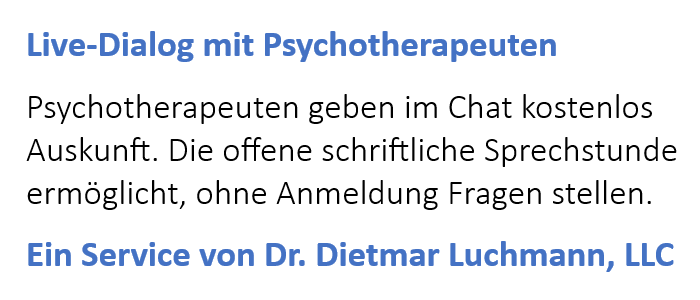
Optionally, a paid consultation appointment for a preliminary telephone discussion with the psychotherapists of Dr. Dietmar Luchmann, LLC, is also available.
Ownership — from Zurich and Dover
The owner of this site is Dr. Dietmar Luchmann, LLC, headquartered in Dover, Delaware (USA) — at the same time the operator of the Anxiety Clinic at Lake Zurich and publisher of the online journal Psychotherapie. The international structure makes it possible to offer cognitive psychotherapy worldwide in English and German, independent of cantonal or state bureaucracy.
The founder is the psychologist and psychotherapist Dietmar Luchmann, with more than 40 years of professional experience in the psychodiagnostics and cognitive psychotherapy of anxiety, panic, and depressive disorders.
Frequently Asked Questions
What is psychodiagnostics?
Psychodiagnostics is the systematic recognition and classification of mental disorders. It answers two questions: which disorder is present (disorder-related diagnostics according to ICD-11) and which therapeutic path suits the individual case (suitability diagnostics). At Dr. Dietmar Luchmann, LLC, it stands at the beginning of every cognitive psychotherapy.
Does the suitability test replace a diagnosis?
No. The anonymous and free suitability test examines the prerequisites for Written Cognitive Psychotherapy, above all the readiness to think, read, and write for oneself. The disorder-related diagnosis is made only in the flat-rate psychodiagnostics and probationary phase with which every psychotherapy begins.
What are online self-tests and self-diagnoses worth?
Little. Self-tests confuse symptoms with disorders: sadness is not depression, stage fright is not social anxiety disorder, a love of order is not obsessive-compulsive disorder. A diagnosis arises from the expert weighing of duration, intensity, course, and impairment — not from checking off symptom lists.
What do the ICD-11 and ICD-10 codes mean?
The ICD is the International Classification of Diseases of the World Health Organization. The ICD-11 is the current edition; the older ICD-10 remains in administrative use in many countries. This page states both codes so that every diagnosis can be found in both systems.
Which disorders does cognitive psychotherapy treat?
All anxiety or fear-related disorders, obsessive-compulsive and related disorders, disorders specifically associated with stress, depression and related mood disorders, as well as anxious-avoidant and narcissistic personality patterns — in each case after psychodiagnostic assessment of the individual case.
Which disorders do you not treat?
Severe depressive episodes, acute suicidality, manic and mixed episodes, psychotic states, and borderline personality disorder belong in specialist psychiatric care, in an emergency in acute psychiatric services. This limit is not a shortcoming of the offering but a result of psychodiagnostics itself.
What does the psychodiagnostics cost?
The suitability test and the registration with goal definition are free of charge. The flat-rate psychodiagnostics and probationary phase is conducted for a fixed flat fee; the individual costs of the subsequent psychotherapy are stated in the concrete offer. All services of Written Cognitive Psychotherapy (WCP), Video-Based Cognitive Psychotherapy (VCP), and Cognitive Psychotherapy in a Day Block (DCP) are self-pay services.
How confidential is the psychodiagnostics?
Maximally. Dr. Dietmar Luchmann, LLC, works outside the healthcare system; no data is passed on to health insurers, authorities, or third parties. The written communication is end-to-end encrypted, the video sessions run without a user account and without recording, and the website completely dispenses with cookies and tracking.
When can the psychotherapy begin?
Immediately, as soon as the suitability test, the registration with goal definition, and the flat-rate psychodiagnostics and probationary phase have confirmed the suitability of the individual case for Written Cognitive Psychotherapy (WCP), Video-Based Cognitive Psychotherapy (VCP), or Cognitive Psychotherapy in a Day Block (DCP). There are no waiting lists like those at insurance-funded practices.